Best grab bars for bathroom safety (2026)
- The best grab bars for shower, tub, and toilet — across permanent wall-mounted and no-drill options
- What actually separates a good grab bar from a dangerous one (weight rating, installation, texture)
- Exactly where to put grab bars — and the installation mistake that makes them useless
- Whether Medicare or Medicaid covers grab bar installation
Falls in the bathroom are the leading cause of home injury for adults over 65 — and the vast majority are preventable. A properly installed grab bar is one of the highest-impact, lowest-cost changes you can make to a home for anyone with limited mobility, joint pain, or balance challenges. It costs less than a single ER co-pay and can prevent injuries that change the trajectory of someone’s life.
But grab bars are not interchangeable. Weight rating, surface material, length, installation method, and placement all determine whether a bar is genuinely useful or just a false sense of security. This guide covers four strong options across two categories — permanent wall-mounted and freestanding no-drill — so you can match the right bar to the right situation.
Installation matters as much as the bar itself. A grab bar is only as strong as its mounting. Bars anchored into wall studs or solid blocking can support a full-weight fall load. Bars mounted with standard drywall anchors can pull out at the worst possible moment — and have. If you’re not sure whether your walls have studs or blocking in the right location, a handyman can assess before you buy. We cover this in detail below.
What to look for in a grab bar for bathroom safety
Most grab bars look similar at a glance. Here’s what separates the ones worth buying:
Weight rating. ADA standards require grab bars to support at least 250 lbs of static load, but real-world fall forces are dynamic and higher. Every bar in this guide is rated at 250–300 lbs minimum.
Rust resistance. Bathrooms are humid by definition. Stainless steel and chrome-over-brass bars outlast cheaper zinc or aluminum options significantly. If a bar is marketed primarily on its finish, check what the substrate is.
Grip texture. A smooth bar is slippery when a hand is wet. Look for knurled or textured grip zones at the contact areas — especially important for shower and tub applications.
Length. Bar length determines the grab zone. For toilet-area installation, 18–24″ is standard. For shower entry and tub, 24–36″ gives more usable reach. Longer isn’t always better — placement and wall space determine what fits.
Permanent vs. freestanding. Wall-mounted bars provide the strongest, most reliable support but require installation. Freestanding security poles offer flexibility for renters or urgent situations — with real tradeoffs in load capacity that we cover honestly below.
Our top picks
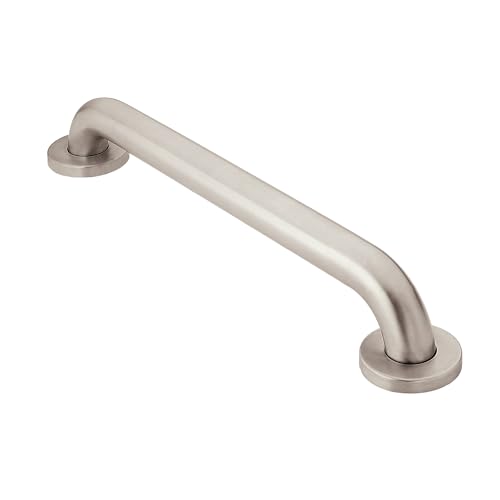
Moen Home Care 18″ Grab Bar
The Moen Home Care line is the grab bar that occupational therapists and Certified Aging in Place Specialists most commonly specify — and it’s easy to see why. It’s built to contractor grade, meaning it’s what professional installers put in renovation projects, not just something sold in a box. The chrome finish sits over solid stainless steel, so it won’t rust, won’t tarnish, and looks like bathroom décor rather than medical equipment.
At 18″, this is the right length for toilet-area installation — mounted horizontally on the side wall within reach from both seated and rising positions. It also works well at the short wall beside a shower entry, or as a secondary bar alongside a longer shower bar. The knurled grip zones at each end provide reliable traction on wet hands.
Moen backs this bar with a lifetime warranty against manufacturer defects — something no cheap grab bar will offer. It’s rated to 500 lbs when installed into a stud or with Moen’s SecureMount anchors, ADA compliant, and available in multiple finishes including stainless, chrome, brushed nickel, and oil-rubbed bronze so it matches your existing fixtures. If you’re buying one bar and want confidence in it, this is the one. It’s the same bar or better than what a contractor would install at twice the cost.
- Contractor-grade quality, not a consumer-grade bar
- Chrome-over-stainless steel — won’t rust
- Looks like décor, not a medical aid
- 500 lb rating, ADA compliant
- Lifetime warranty from Moen
- Available in three finishes to match fixtures
- Requires drilling into studs or blocking
- 18″ may not be long enough for tub wall or shower
- Chrome finish shows water spots in some bathrooms

Moen Home Care 36″ Grab Bar
The 36″ version of the Moen Home Care bar is the right choice for the long wall of a tub enclosure or the main wall of a shower. At this length, you can mount it horizontally at a height that supports both standing balance and assisted lowering — or install it diagonally (angled 45° on the tub wall) to support multiple phases of a tub transfer without repositioning.
OTs frequently recommend the diagonal installation on the tub long wall because it allows the user to push up from a lower grip point and transition to an upright position using the same bar. This is particularly valuable for people with arthritis affecting the hips or knees, post-hip-replacement patients, or anyone who struggles with the mechanics of getting in and out of a tub.
Everything else about this bar is identical to the 18″ pick above — same Moen Home Care line, same lifetime warranty, same stainless steel construction, same ADA compliance. If you’re doing a full bathroom modification, most OTs would specify the 18″ at the toilet and the 36″ in the shower or on the tub wall. Buying both lets you match the finish across the whole bathroom.
- Right length for tub wall and shower
- Can be installed horizontal or diagonal (45°)
- Same lifetime warranty and ADA compliance as the 18″
- Larger grab zone than a short bar
- Matches the 18″ bar in finish if buying both
- Needs two stud locations or solid blocking
- Larger footprint — requires adequate wall space
- Too long for most toilet-area installations

Stander Wonder Pole & Curve Grab Bar
When wall-mounted bars aren’t possible — because of rental restrictions, ceramic tile walls you can’t drill, or a situation where someone needs a solution this week rather than waiting for a contractor — the Stander Wonder Pole is the most credible no-drill option available. It uses a floor-to-ceiling tension system (similar in concept to a tension curtain rod, but engineered for weight-bearing use) and includes a curved grab bar section you position at the right height.
The curved grab section rotates 360° around the pole, so you can orient it exactly where it’s most useful. It can be placed beside the toilet, at the shower entry, beside the vanity, or anywhere the ceiling permits. No studs, no tile drilling, no tools required — the whole installation takes about ten minutes with a wrench.
The honest caveat: no tension-mounted system performs identically to a properly wall-anchored bar under dynamic fall loads. The Stander is rated to 300 lbs static weight and it’s a genuinely solid piece of equipment, but it’s best used as a balance support aid — something to hold while standing or transitioning — rather than a primary intervention for someone at high fall risk. That said, for many people and situations, it’s meaningfully better than no bar at all.
- No tools, no drilling, no wall or tile damage
- Repositionable as needs change
- Works in rentals, apartments, and care facilities
- Adjusts to ceiling heights from 7′ to 10′
- 300 lb static rating
- Curved bar section rotates to any position
- Not as strong as a wall-mounted bar under fall loads
- Requires flat, solid floor and ceiling (no popcorn ceilings)
- Larger visual footprint than a wall bar
- Ceiling must be in the 7’–10′ height range

Drive Medical Grab Bar
Drive Medical is a well-established name in home medical equipment — the same brand behind several well-regarded rollators and mobility aids. Their grab bars are a strong, no-frills option when the Moen price point isn’t the right fit. Drive bars meet ADA standards, come in multiple lengths (12″ through 32″), and include a knurled grip surface that the cheapest bars often omit entirely.
The specific model linked here (RTL12012) is a white powder-coated steel bar — worth knowing if you’re trying to match a chrome or brushed nickel bathroom. Drive Medical also makes bars in other finishes, so if white doesn’t work, check their lineup. Powder coating is reasonably durable in bathroom conditions; check the mounting hardware for corrosion after the first year in high-humidity bathrooms.
The availability in multiple lengths is a practical advantage. If you’re outfitting a full bathroom — toilet, shower entry, tub wall — the Drive Medical line lets you cover more locations for the same cost as a single or two Moen bars. For families doing a comprehensive home modification on a real-world budget, that tradeoff is often the right one.
- Lower price — good for multi-bar installations
- ADA compliant, multiple lengths available
- Knurled grip surface for reliable wet-hand traction
- Well-established medical equipment brand
- 300 lb weight rating
- White powder-coated finish — won’t match chrome or brushed nickel bathrooms
- No lifetime warranty (Moen has one)
- Finish quality lower than Moen Home Care line
Quick comparison
| Grab bar | Type | Best location | Weight rating | Drilling required |
|---|---|---|---|---|
| Moen Home Care 18″ | Wall-mounted | Toilet, shower entry | 500 lbs | Yes |
| Moen Home Care 36″ | Wall-mounted | Tub wall, shower wall | 500 lbs | Yes |
| Stander Wonder Pole | Freestanding | Toilet, shower entry | 300 lbs static | No |
| Drive Medical | Wall-mounted | Any bathroom location | 300 lbs | Yes |
Where to put grab bars — and the mistakes that make them useless
Where and how you install a grab bar matters as much as which bar you choose. A bar in the wrong position provides limited benefit and can encourage awkward body mechanics that actually increase strain.
At the toilet. Mount a horizontal bar on the dominant-hand side wall (typically the right wall when seated), so the bar is within reach from both seated and half-standing positions. Standard height is 33–36″ from the floor. A bar on both sides is ideal; when only one side is possible, dominant hand wins. The bar should extend past the front edge of the toilet so it’s reachable during the push-to-stand phase of the transfer.
For tub entry. A vertical bar at the entry end of the tub (at the faucet end) helps with the step-over. A second horizontal or diagonal bar on the tub long wall supports lowering in and rising out. The diagonal installation at 45° is particularly effective because it supports the full arc of a tub transfer with a single bar — you grip lower going down, higher coming up.
In the shower. A horizontal bar at 33–38″ from the floor on the wall you face works for most users. For a walk-in shower with a threshold, a vertical bar at the entry is valuable. For people with significant mobility limitations, an L-shaped bar (horizontal + vertical in one piece) covers both the threshold step and the standing balance need.
The most common installation mistake: mounting the bar too high. People tend to install at the height they’d grip a wall for light balance — which is too high for real fall prevention use. A bar at 33–36″ from the floor lets a person push themselves fully upright using their full arm and shoulder strength, not just lean against it. Higher bars only work for the final phase of standing, not the hardest part of the lift.
A note on installation
For most people, the right approach to grab bar installation is one of three paths:
- DIY if you have basic drilling skills, a stud finder, and the bar’s mounting points land in studs. All the wall-mounted bars in this guide include mounting hardware and instructions. The Moen bars include a paper template for marking drill points.
- Hire a handyman if your studs aren’t in the right locations and the wall needs blocking added, or you have ceramic tile that requires a specialized tile bit. Most handymen charge $75–$150 to install one or two grab bars — worth it compared to the risk of a bar pulling out of drywall under load.
- Contact a CAPS specialist if you’re doing a broader bathroom modification for someone with significant mobility limitations. A Certified Aging in Place Specialist can assess the full bathroom and specify exactly what’s needed and where. Many work with contractors to complete the full scope.
Does Medicare cover grab bars?
In most cases, no. Medicare Part B does not cover grab bars as durable medical equipment. Unlike rollators, hospital beds, or commodes, grab bars are classified as a home modification, and Medicare generally doesn’t cover home modifications regardless of medical necessity.
Medicaid Home and Community-Based Services waivers may cover grab bar installation for eligible recipients, depending on your state. Some states also have home modification grant programs specifically for seniors and people with disabilities. The Eldercare Locator can connect you with local programs, and many Area Agencies on Aging offer free or low-cost installation programs for qualifying households.
Frequently asked questions
How much weight does a grab bar need to support?
ADA standards require 250 lbs, but real-world fall forces are higher than static weight. The wall-mounted Moen bars in this guide are rated to 500 lbs when properly anchored; the Stander pole to 300 lbs static. More important than the bar’s rating is the installation — any bar mounted in drywall without a stud can fail at far lower loads.
Can I install a grab bar without hitting a stud?
Not reliably for safety-critical use. Drywall anchors are not engineered for the dynamic loads of a fall. If your studs aren’t in the right location, the right solution is to add blocking — a horizontal board installed inside the wall between studs, giving you a solid anchor surface anywhere along its length. A handyman can do this as part of the installation job for modest additional cost.
What angle should grab bars be installed?
Horizontal is the most versatile and works for most locations. Diagonal at 45° on a tub long wall is preferred by many OTs because it supports multiple phases of a tub transfer with one bar. Vertical bars work best at entry points where the movement is primarily up-and-down. Avoid angles between 20° and 45° — that range can catch and trap a falling person’s wrist.
Are grab bars helpful for arthritis?
Yes — they’re one of the most-recommended modifications for people with arthritis affecting the hips, knees, or lower body. Grab bars reduce the joint load of toilet transfers and tub entry, which is often when joint pain is most acute. Pairing a grab bar with a raised toilet seat is a particularly effective combination for arthritis patients.
Our bottom line
For most homes and most people, the right approach is straightforward: a Moen Home Care 18″ beside the toilet and a Moen Home Care 36″ on the tub or shower wall, mounted into studs or blocking. This covers the two highest-risk bathroom locations with contractor-grade hardware that will outlast the bathroom. If you only buy one bar, the 18″ at the toilet is the higher-priority location.
If wall installation isn’t possible, the Stander Wonder Pole is a credible freestanding alternative — no tools, no drilling, and genuinely useful for renters or situations where you need a solution quickly. For multi-bar installations on a tighter budget, the Drive Medical line lets you cover more locations without sacrificing ADA compliance or knurled grip.
If you’re modifying a bathroom for someone with Parkinson’s, MS, stroke recovery, or significant mobility loss, also consider our guides to mobility aids and equipment and best rollators for Parkinson’s disease — bathroom safety and mobility support work together.